※This article explains the types and selection of cooling towers and chillers. It provides guidance on choosing the right equipment based on factors like environmental conditions and cooling capacity. For more detailed information, be sure to check out additional related articles for further insights.
Types and Selection of Cooling Towers and Chillers
Cooling towers (CT) and chillers come in various types, each suited for different environmental conditions despite having similar roles. The equipment selection depends on factors like the installation environment, cooling needs, and efficiency requirements. Various options are available to ensure optimal performance in different settings.
Cooling towers come in different types
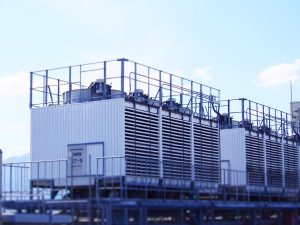
Cooling towers (CT) are mainly classified into two types: “water-cooled” and “air-cooled.” The “water-cooled” system is further divided into two categories: “open-type CT” and “closed-type CT.” Each type has unique features, offering different advantages based on the installation environment and cooling requirements.
We will introduce the features of each.
An open-type cooling tower (CT)
An open-type cooling tower (CT) cools water by directly exposing it to the outside air, which makes it more efficient than a closed system. This type is commonly used in Thailand, with over 90% of systems utilizing it. However, it can become contaminated with debris and bacteria due to exposure to the environment.
Chillers, pipes, and pumps can also accumulate dirt, so regular cleaning is not enough. Water treatment measures such as softeners and chemical additives are necessary. However, while chemicals can slow scale and rust buildup, they do not address the root cause. In many cases in Thailand, after about 10 years, the internal pipes inevitably experience blockage.


A closed-circuit cooling tower (CT)
A closed-circuit cooling tower (CT) features copper pipes inside the tower through which cooling water flows. The outer side of the tower has filling material, and water is sprayed over it, cooling down in the same way as an open system. The key difference is that the water inside the system never directly contacts outside air, reducing contamination risks.
In a closed-circuit cooling tower (CT), the heat from the cooling water inside the copper pipes is transferred through the pipes to the spray water outside. This allows the cooling water to be circulated without direct contact with outside air, which reduces the risk of contamination and lowers maintenance costs.

Types of chillers
Chillers work by evaporating refrigerant to lower the temperature of water, which requires a refrigeration cycle. Here, we’ll focus on chillers primarily used for air conditioning, highlighting their features. These systems use a refrigerant that undergoes phases like evaporation, compression, and condensation, helping in maintaining a cooling effect for large spaces.
Vapor Compression Refrigeration Machine
The most commonly used refrigeration system is the vapor compression type. Its key feature is the compression of gaseous refrigerant using a compressor. The compressor is driven by mechanical energy and comes in two main types: positive displacement and centrifugal. The centrifugal type, known as the turbo chiller, is the most widely used.
After the refrigerant is compressed and reaches high pressure, it is cooled in the condenser where it releases heat to the cooling water, transforming into a high-pressure liquid. Then, the pressure is reduced via the expansion valve, and the refrigerant evaporates at a low temperature in the evaporator.
The advantages of the steam compression refrigeration system include lower initial costs, compactness, high coefficient of performance (COP), and longer maintenance intervals. However, its drawbacks include noise and the requirement for qualified personnel due to the use of high-pressure gases.
Absorption Chiller
The absorption chiller differs from the vapor compression chiller in that instead of using a compressor to return the evaporated refrigerant to a liquid state, it uses a highly absorbent liquid. The refrigerant used is water, and the absorbent is lithium bromide.
The benefits of absorption chillers include lower power consumption, no use of refrigerants like Freon, and no need for specialized qualifications to operate them. Additionally, they can supply both cold and hot water, providing added flexibility.
The disadvantages of absorption chillers include the larger size of the cooling tower (CT), longer startup times, and the complexity of regular maintenance checks.
Summary: Choose cooling systems based on your needs
Cooling towers and chillers come in various types, and choosing the right one depends on the installation environment and intended use. Understanding their unique characteristics is essential to implement the most suitable system for optimal performance.