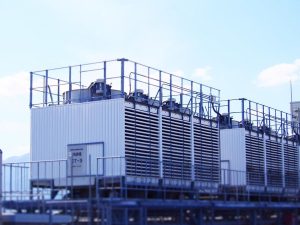

※This article provides a detailed explanation of the basic knowledge of cooling towers and chillers. For further details, please also refer to the related articles listed below.
Basic Knowledge of Cooling Towers and Chillers
Cooling towers and chillers are used in the air conditioning systems of large-scale facilities such as buildings and factories. This section explains the characteristics of each.
What Are Cooling Towers and Chillers?
A cooling tower is a device that cools the “cooling water” returned from a chiller, while a chiller is a device that produces “chilled water.”
Air conditioning in large buildings and factories uses the “chilled water” produced by chillers. Cool air is created by directing air over this “chilled water” to cool down the space and provide a comfortable environment.
How Cooling Towers and Chillers Work
This section introduces the mechanisms of cooling towers (CT) and chillers, explaining their respective characteristics.
How Cooling Towers (CT) Work
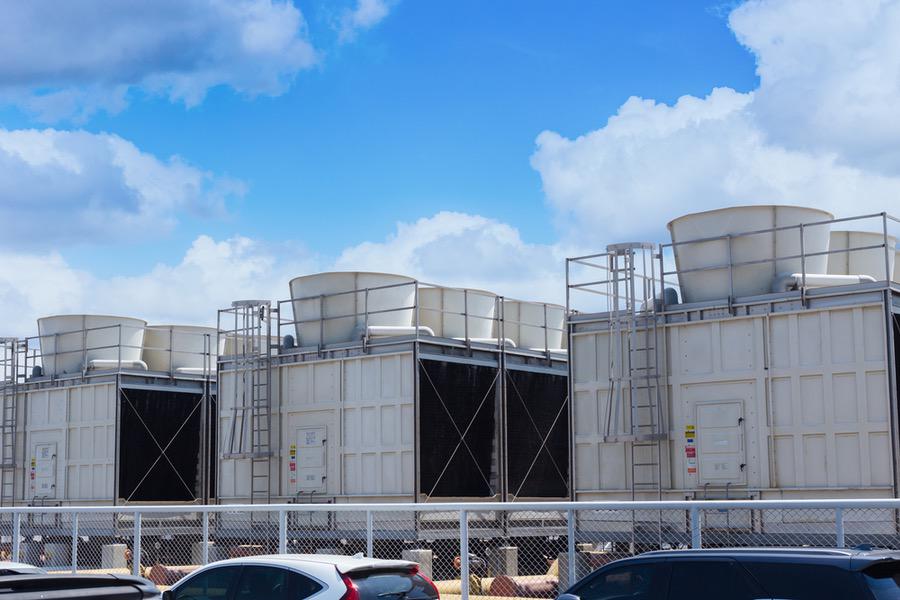
The mechanism of a cooling tower (CT) is based on the same principle as feeling cool when water is sprinkled on hot asphalt. As the water evaporates, it absorbs heat, cooling the remaining water. This process, called latent heat change, accounts for 80% of the cooling effect.
To cool more efficiently, it is crucial to maximize the contact between the cooling water and outside air. This is where fans and fill media come into play. The fan draws in the outside air, and the fill media facilitates the contact between the cooling water and the air.
How Chillers Work

The mechanism of a chiller is also based on the principle of evaporative cooling. However, it is part of a larger system called the “refrigeration cycle.” Within this cycle, there is a step known as the “evaporation process.”
In chillers, the evaporation latent heat is used to generate cold energy, but to enhance evaporation, refrigerants are utilized. These refrigerants can be natural or fluorocarbons. The “refrigeration cycle” includes not only the evaporation process but also steps like compression, condensation, and expansion. These processes occur in a sealed, robust container where the refrigerant circulates.
To reuse the refrigerant, it must be converted back from its gaseous state to liquid, which occurs during the “condensation” process. The cooling water from the cooling tower plays a key role in this process. As a result, the cooling water gets heated, which is then cooled down again by the CT. The refrigerants used include carbon dioxide, water, and ammonia, while fluorocarbons are categorized as specific, designated, and alternative fluorocarbons.
Summary: Understanding the Basics of Cooling Towers and Chillers
While a cooling tower (CT) operates under atmospheric pressure and is influenced by the outside air wet bulb temperature, a chiller works within a sealed container, using energy to operate at high pressure or near-vacuum conditions. This is a major difference between the two systems.
By understanding the mechanisms of each system, it becomes easier to select the appropriate system for your needs.